Our Spanish courses are aimed at Russian-speaking children who have settled in Barcelona and need to learn the language from scratch or improve the level they already have.
Arriving in a new country as a child is not easy: you have to understand the teacher, make friends, and keep up with school lessons. The aim of the course is for that to happen as soon as possible, working on the language needed in real life.
Bilingual teaching staff
At Sodruzhestvo, classes are taught by bilingual teachers who are fluent in both Russian and Spanish, and are familiar with the methodology for teaching Spanish as a foreign language.
In the early stages this changes everything. A child who doesn't understand a single word of what is said to them makes slow progress and gets discouraged. Being able to explain a rule in their language, resolve a doubt straightforwardly and support them while they gain autonomy is what keeps learning from stopping.
How do we work?
01
Very small groups
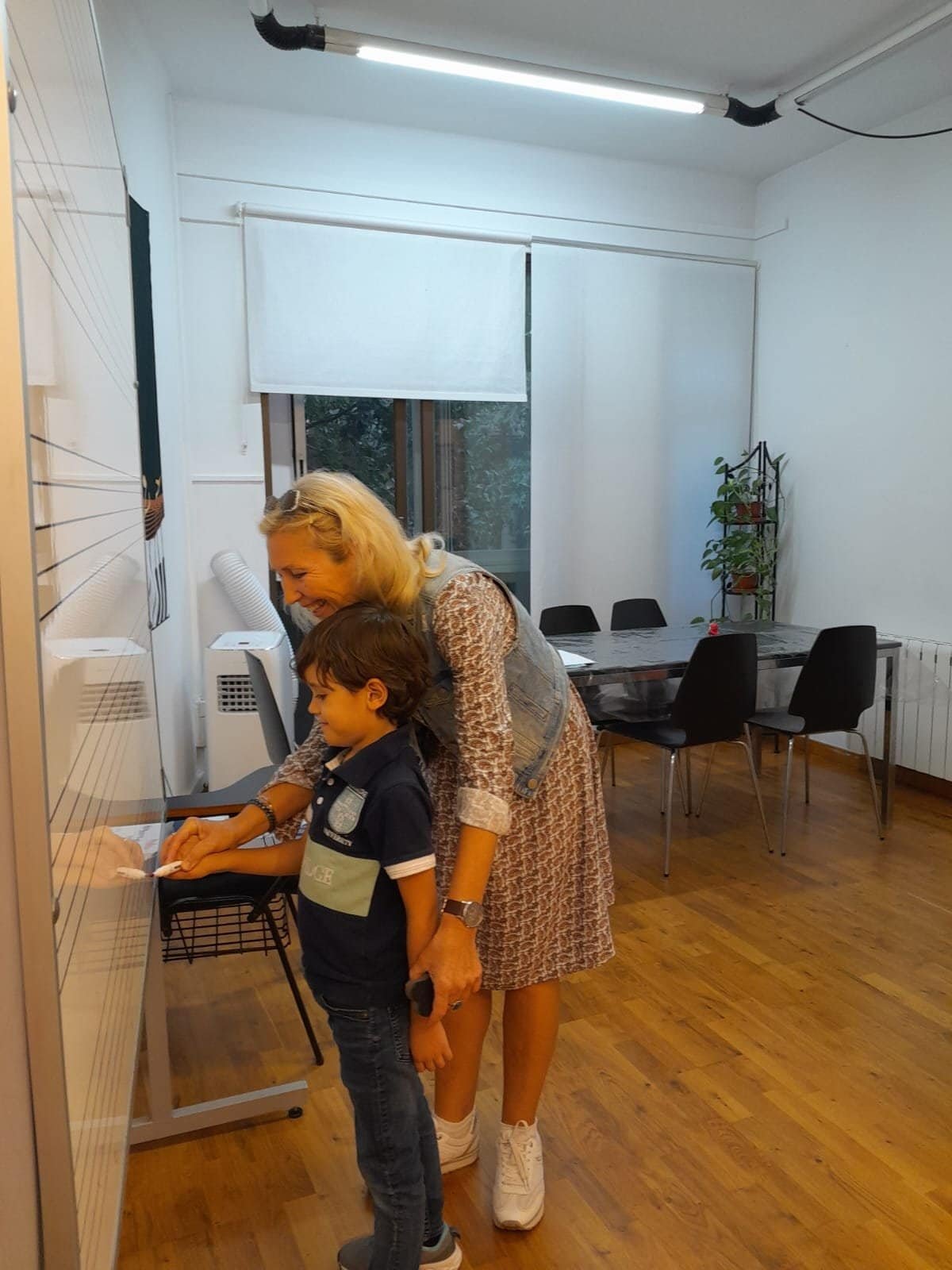
Individual classes or in groups of two or three students. Family groups also available.
02
Grammar and vocabulary
Systematic work on structures and progressive vocabulary expansion.
03
Writing
Spelling, copy-writing, dictation and essay writing.
04
Conversation from day one
The classes are set up as a game: the children memorise effortlessly and rehearse real-life situations.
05
Help with homework
Help with school Spanish homework.
06
In-person or online
We offer face-to-face or online classes.
We use teaching materials approved by the Spanish Ministry of Education for students who have recently arrived in the country.
The courses
Annual course
Basic and initial level.
Groups of 3-4 pupils.
45 hours per module · 4 months.
Intensive one-to-one course
40 hours a month.
Individual or in a very small group.
One-to-one semi-intensive
20 hours a month.
Individual or in a very small group.
Summer intensive courses
Intensive and semi-intensive courses in July and August.
No. We have beginner-level groups that start from scratch. In the initial levels, the teachers can use Russian for explanations, which makes getting started much easier.
Classes are in Spanish from the beginning, but at the initial levels the teachers resort to Russian when something needs to be clarified. As you progress, the use of Spanish is total.
Yes. We prepare you for both the DELE A2 and the CCSE, the two tests required for the citizenship by residency application. We also guide you on deadlines, registration and documentation.
The DELE is a permanent diploma that certifies a specific level and is issued by the Instituto Cervantes. The SIELE is an exam that scores your level on a scale and is valid for five years; it is quicker to obtain and is taken on a computer. The DELE A2 is required for nationality.
We offer both formats. The groups are small, which allows for plenty of speaking practice. Individual lessons are an option if you are looking for a very specific schedule or want to progress at a different pace.
Yes. The online course follows the same syllabus and is taught by the same teaching staff as the face-to-face course, and you can combine the two throughout the academic year.
We work with children and adults in separate groups, with materials and a pace tailored to each age. For children starting school in Barcelona, the classes also serve as support to keep up with the school year normally.
Yes, and they are complementary. In Catalonia both languages are needed: Catalan is the vehicular language at school and Spanish is the one for general use outside of it. We also offer Catalan classes.
Enrolment is open all year round. You can join at any point during the course: we’ll carry out a placement test beforehand to place you in the appropriate group.
More educational provision
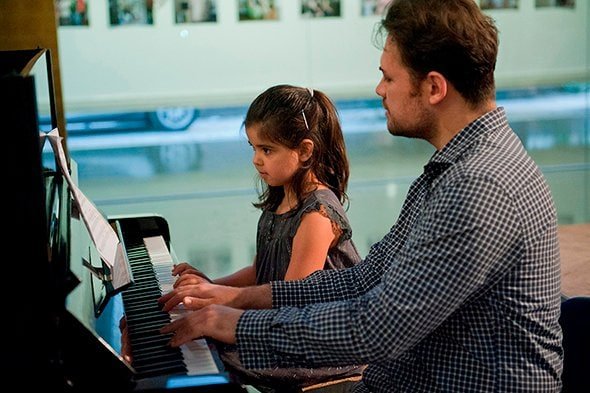
At the Academy we offer music classes, art workshops and a programme open to the whole family.